
From 3D CAD Model to Manufacturing Package: Why Engineering Release Is Ready for AI
Artificial intelligence is advancing engineering automation beyond simple 2D drawing generation. Drafty converts 3D CAD models into production-ready drawings, manufacturing outputs, validation records, and release decisions—while maintaining human oversight.
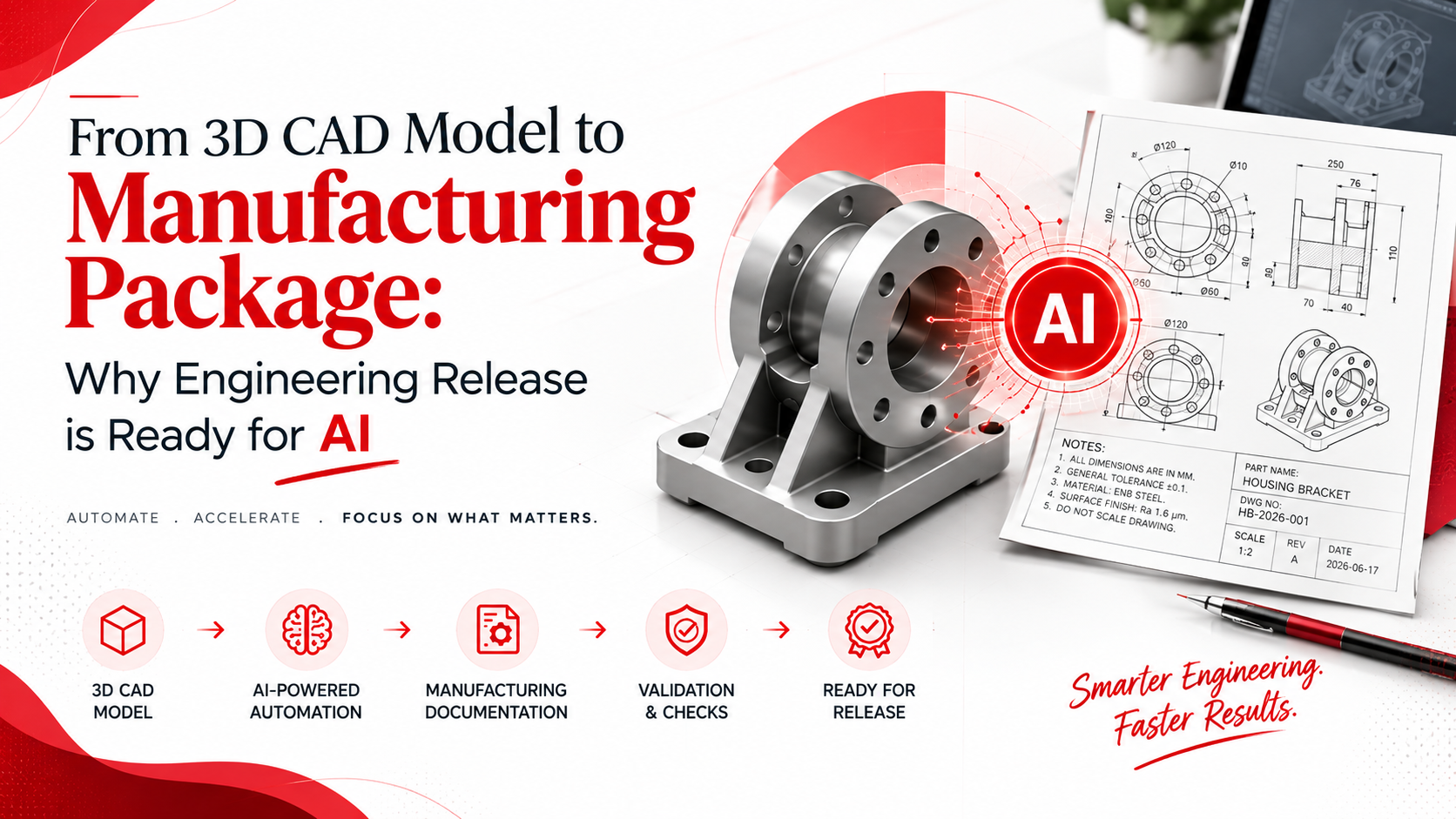
Completing a 3D CAD model is just the beginning of the engineering process. Moving a design into manufacturing requires substantial additional documentation work, including generating drawing views, adding dimensions, tolerances, and notes, preparing flat patterns, adhering to company standards, and verifying all information. Finishing the 3D model does not end the engineering effort, leaving a major workflow between design completion and manufacturing release. Because much of this post-design work is repetitive, structured, and rule-based, it represents a prime opportunity for AI automation.
The Hidden Work After a 3D Model Is Finished
A 3D model provides a digital representation of a component or product. It captures its geometry and, depending on the CAD environment, can also contain information such as material, features, relationships, and other model properties.
But manufacturing requires beyond geometry.
A production team may need a 2D engineering drawing that communicates dimensions, tolerances, surface finishes, manufacturing notes, inspection requirements, and other details necessary to produce and inspect the component.
That means the workflow doesn't simply end when the engineer clicks “save” on the 3D model.
The model may need to be translated into appropriate drawing views. Sections and detail views may need to be created to communicate important features. Dimensions and geometric tolerances need to be positioned correctly. Manufacturing notes and annotations may need to be added. Drawing layouts need to be checked for completeness.
For a single, simple component, these activities may not seem significant.But engineering teams rarely work on just one component.
When an organization is handling dozens, hundreds, or thousands of parts, product variants, assemblies, and design revisions, these repeated documentation tasks can become a substantial workload. The underlying challenge becomes even greater when a design changes because that modification can affect drawings, BOM structures, assembly information, and other downstream documentation.
This creates an interesting paradox.
Engineering software has made creating complex 3D designs faster and more sophisticated, but the work required to prepare those designs for release can still involve a considerable amount of manual effort. That is the hidden work after the 3D model is finished.
A Drawing Is Not the Same as a Release Package
One of the biggest misconceptions around engineering automation is that the problem can be reduced to generating a 2D drawing from a 3D model. Drawing generation is certainly an important part of the workflow. But a manufacturing release package can involve considerably more information.
A complete release package requires far more than basic geometry; it must include clear views, dimensions, tolerances, manufacturing notes, material specifications, BOM data, revision details, and downstream exports. Consequently, a critical distinction exists between generating a simple 2D drawing and preparing a fully validated, release-ready package—a challenge known as design-to-release automation.
Before You Press Print: Why AI Needs Local Context and Pre-Release Validation
AI automation in engineering cannot rely on generic templates; it must adapt to specific workplace constraints and rigorously validate outputs to be manufacturing-ready.
Engineering workflows are governed by a complex mix of universal industry standards (like dimensioning and tolerancing) and hyper-local rules, including internal company policies, supplier limitations, and specific manufacturing processes. Because these requirements vary from one organization to the next, a generic AI approach falls short. For AI to truly transform engineering workflows, it must achieve two core capabilities: Contextual Adaptation: The AI must identify and apply the exact combination of global standards and internal company rules—such as specific drawing layouts, revision controls, and production constraints—that apply to the specific project.
Pre-Release Validation: Generating a document or drawing is only the first step. The AI must independently verify the output against all workflow rules, check for consistency with the latest engineering models, and ensure all required data is present to prevent costly downstream manufacturing errors.
Meet Drafty
This is the problem Drafty is designed to address. Drafty is an AI-powered engineering system designed to turn 3D CAD models into production-ready 2D drawings, flat patterns, and manufacturing exports.
But describing Drafty as a drawing generator would miss the bigger idea behind it. Drafty is designed to interpret the model, choose the appropriate drawing strategy, apply engineering standards and company policies, validate the resulting output, and determine whether the package is ready for release or should move to exception review.
The vision is not simply: 3D model → 2D drawing It is: 3D model → Engineering interpretation → Documentation → Manufacturing outputs → Validation → Release decision That difference matters. Because the real bottleneck isn't always creating the design. Sometimes, it is everything that happens after the design has been created and before it can be released.
Flipping the Script from Headcount to Leverage
AI shouldn't replace engineers; it should give them leverage. The goal is to eliminate the grunt work so engineers can focus on what they actually went to school for—solving messy design problems and making the big calls that require real human judgment. The real question we should be asking is whether AI can understand the design-to-release workflow well enough to execute it reliably. Drafty is being developed specifically to address this capability. Completion of a 3D model ought not to necessitate another manual workflow.
Related reading

Software 3.0 Is Here: Why Traditional Software Agencies Must Reinvent Their Business Model or Die
Traditional software agencies face an existential shift as Software 3.0 replaces human-operated apps with autonomous AI agents. Learn why hourly billing and basic app development are dying, and discover the four critical business pivots—from outcome-based pricing to AI governance—required to thrive in the new era.
3 min read

How SMEs win government software tenders in the UK
Where UK software tenders are published, what the Procurement Act 2023 changed for small firms, and how to write bids that score. A practical guide.
6 min read
How much does an MVP cost in the UK in 2026?
UK MVP prices for 2026 by type, from simple web apps to AI and marketplace builds, what drives the cost, how long it takes and how to spend less on it.
7 min read